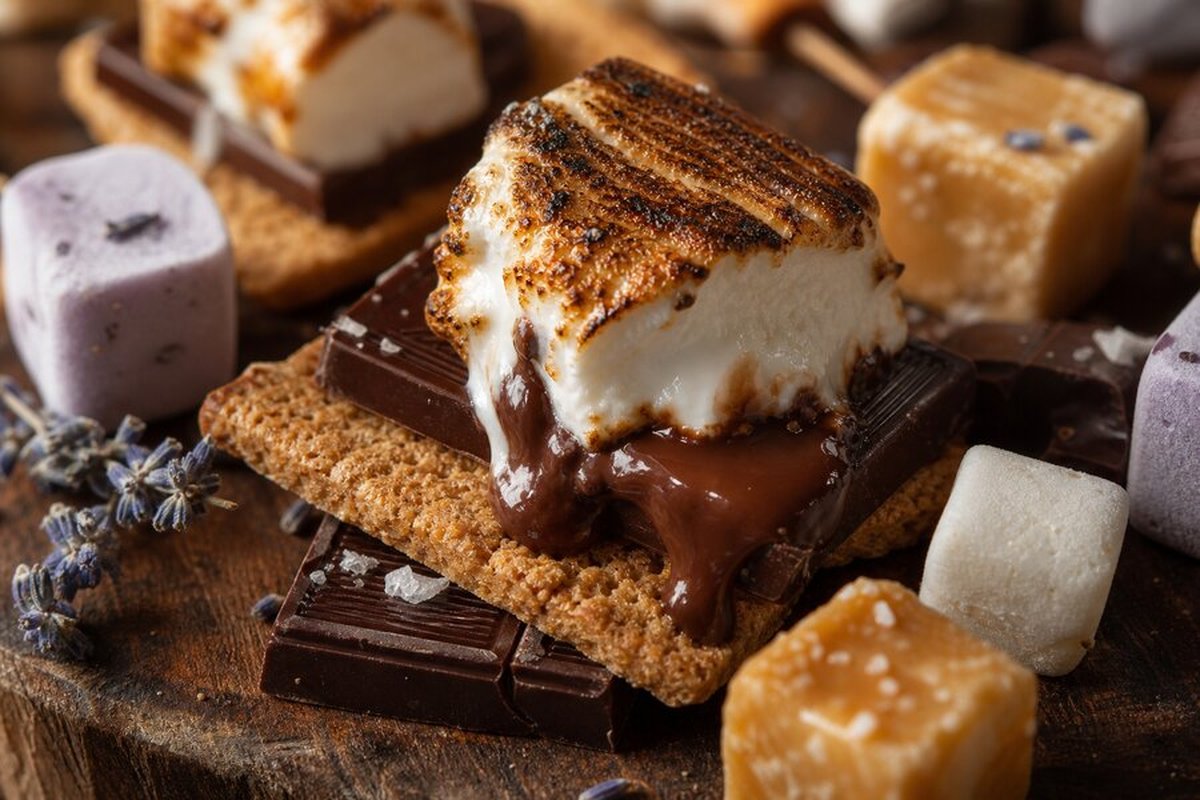
Consider the marshmallow: a foam of air trapped between two thin sheets of sugar, held together
by collagen or gelatin and dusted with cornstarch so nothing will stick. A child carries it crumpled
in a pocket to school; a coffeehouse steeps it in matcha; an outdoor fire draws families around the
singe-scarred rectangle we call a s’more. Yet every one of these forms descends, through chemical
shortcuts and industrial scale-up, from a wild herb that grew ankle-deep in swamps
along a river which has not known annual inundation at its old levels since nineteen
seventy.
The marshmallow’s journey is, perhaps uniquely among sweet confections, a biography of
cross-cultural exchange: Egyptian physicians prescribed Althaea officinalis—the ancient
“marsh-mallow” root —for respiratory ailments and wound healing; medieval Arab gastronomes in
Cairo turned its sap into a courtly medicinal paste with honey and rosewater; French apothecaries
in the eighteenth century whipped it into novelty candies; American factories after the Second
World War pressed millions of pale pillows through extruders, birthing the brand-name era that
dominates pantry shelves today.
Over five hundred million pounds move through retail channels each year; a vegan sub-segment
spikes at double-digit annual growth rates; and a constellation of artisanal shops in Brooklyn,
Manchester, Melbourne, and Tokyo offers hand-cut blocks perfumed with lavender, yuzu, or
toasted koji —a small-scale resurrection of the original craf
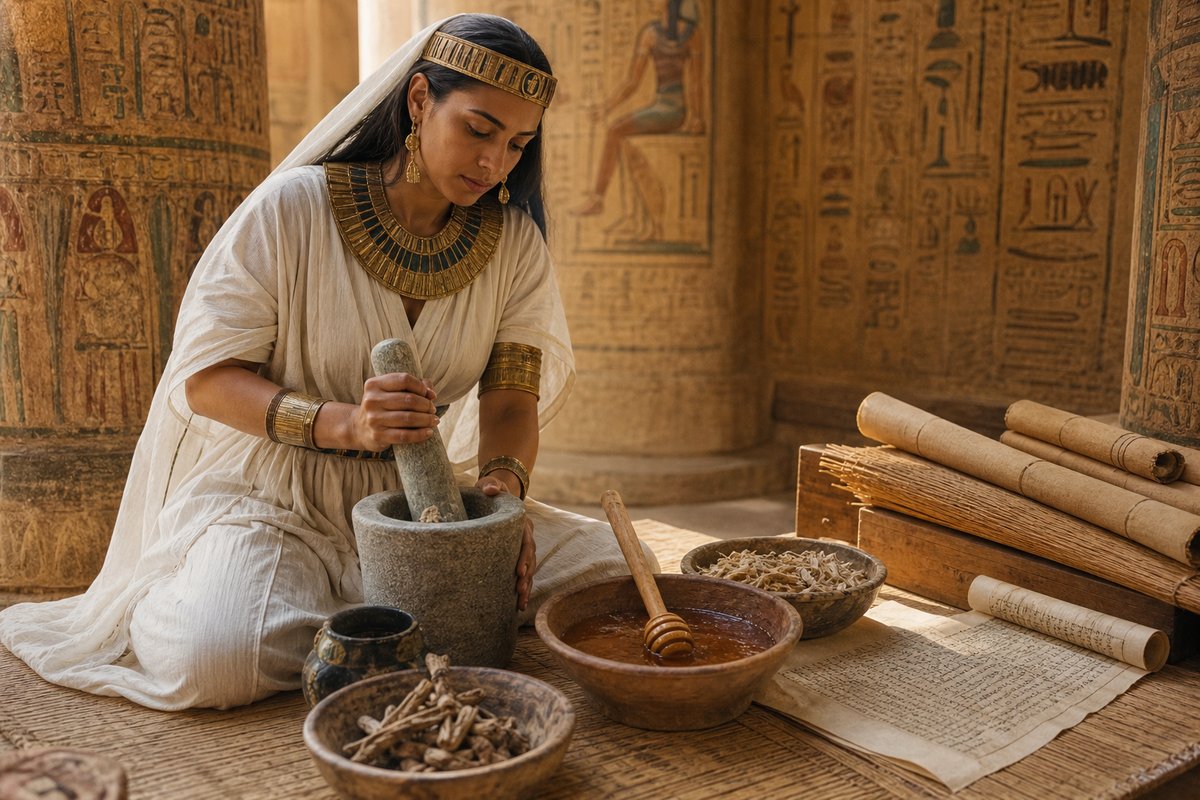
Figure 1: A priestess preparing a honey-marshmallow root paste in an Egyptian temple setting, inspiredby historical sources describing the medicinal preparation of Althaea officinalis at sacred centres alongthe Nile Delta.
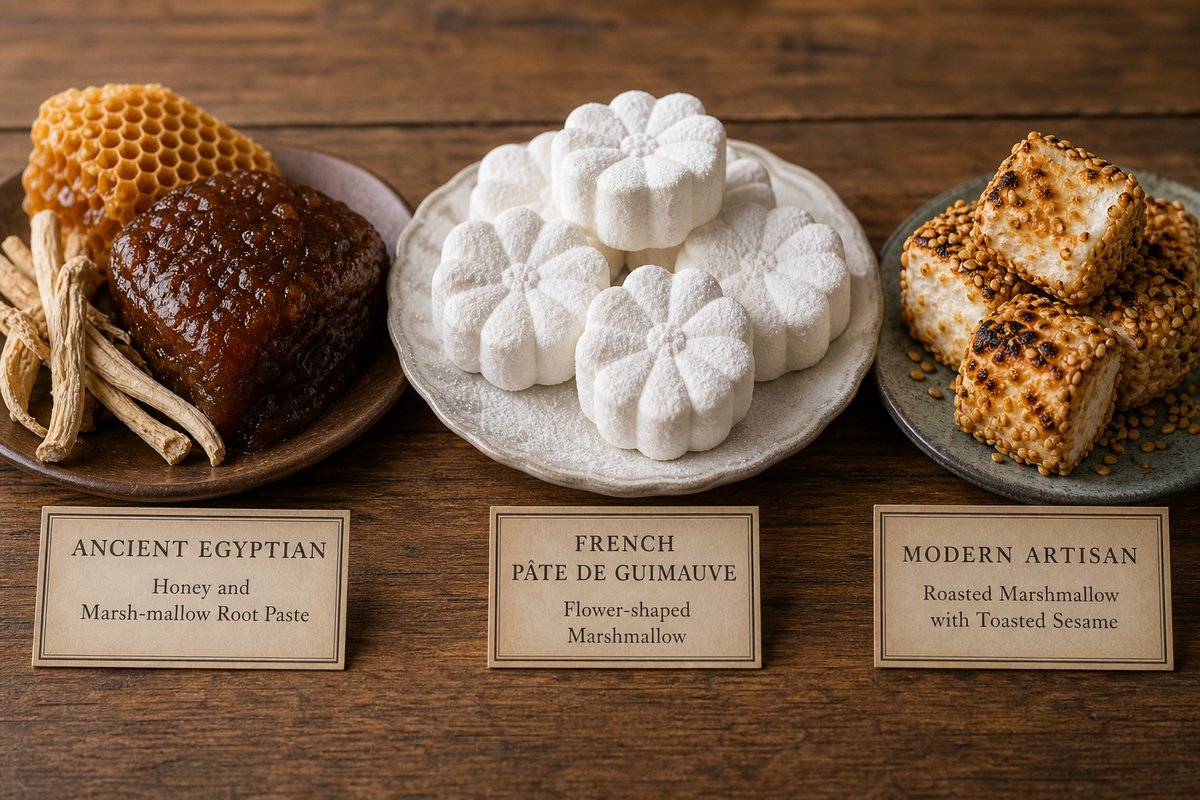
Figure 2: Three distinct marshmallow preparations from left to right: ancient Egyptian-style honey-pastewith honeycomb and dried marshmallow roots; French pâte de guimauve flower-shaped marshmallowsdusted with cornstarch; and a modern artisan roasted marshmallow coated in toasted sesame seeds.
1 From the Nile to Alexandria: Ancient Origins
The marsh-mallow plant, Althaea officinalis, is a member of the mallow family (Malvaceae) that
thrives in moist soils and brackish pools across the Mediterranean catchment and into western
Asia. Ancient Egyptian naturalists noted its thick, slender underground stems exuding the
sticky mucilage that the Greeks later termed malake “softness.” In practice, the plant
was harvested by canal-diggers and marsh-wardens along the Delta and upper Nile
from at least the second millennium BCE. The Ebers Papyrus (circa 1550 BCE) lists a
combination of “marsh-mallow juice” with figs, dates, and honey as an electuary for soothing
throat inflammation — it is among the earliest known references to marshmallow as
medicine.
The Egyptian understanding was empirical but not wholly inaccurate: mucilage-rich roots
reduce localised irritation in oral and pharyngeal tissues, a property that led later Greco-Roman
physicians including Dioscorides (fl. 60 CE) to prescribe root extracts for bronchial complaints.
What distinguishes the Egyptian formulation, however, is its sweetening strategy. Egyptians had
domesticated large-scale date-palm syruping and commercialised honey as a preservative; mixing
marsh-mallow sap with honey produced a paste that, once dried on reed mats or clay plaques, kept
for months without refrigeration.
These early “candied mallow blocks” travelled with merchants and pilgrims around the
Mediterranean basin; when Roman gastronomers like Apicius (fl. 1st century CE) recorded sweet
pastes bound by egg-white foam and flavoured with thyme or saffron, they were likely documenting
a technology informed by Egyptian tradition that had filtered through Greek apothecaries
first.
2 Cairo’s Apothecary Kitchens: Medieval Arab Preparations
When Islamic scholars translated Greek and Persian medical treatises during the Abbasid era
(8th–10th centuries CE), they refined the marshmallow recipe far beyond its therapeutic utility.
The great polymath Al-Biruni (c. 973–1048 CE) recorded in his Tarikh schematics for a sweetened
root paste prepared by boiling fresh marsh-mallow stems until they yielded their mucilage, then
straining the liquid through fine linen and reducing it with honey and rosewater to a viscous jelly.
The result was stored as crystalline cakes that could be grated over sherbet or steeped in hot water
as an aromatic tea.
Cairo’s att’arinin — the apothecaries who served both the Mamluk courts and the ordinary
quarters around Al-Mu’izz street — saw the marshmallow paste transfigure from a medicine
prescribed by weight into a luxury confection sold in small wrapped tokens. Ibn Bassám’s
12th-century cookbook includes specific proportions: 500 g marsh-mallow mucilage
to 300 g floral honey with a pinch of crushed pistachio and powdered orange-flower
water.1
A distinguishing feature was refinement. Medieval Arab confectioners introduced two crucial
modifications that separated their “purified pastes” from every later European derivative: (1) they
used egg whites as an auxiliary whipping agent in some versions, producing a lighter foam; and (2)
they dusted the set confections with rose-scented powdered sugar — a technique foreshadowing
nineteenth-century European practice.
This Cairo-era sweet became a direct ancestor of the French pâte de guimauve that would
appear three centuries after Islamic rule receded from the Levant. A continuous line of craft
knowledge runs along trade routes: Alexandria → Damascus → Baghdad → Sicily (after the
Norman conquest, 1071 CE) → southern France.
3 European Sweetness: From Apothecary Shelf to Patisserie Counter
By the late sixteenth century, the marshmallow root had found its way into French herbals and
court kitchens. The first genuinely documented European form occurs in the early seventeenth
century when Parisian apothecaries began dispensing a whipped foam — substituting egg-white
whipping for the heavy reduction methods of their Arab predecessors.Vin de guimauve was
consumed as a digestive cordial; it took another century and a half before Parisian
confectioners repurposed the recipe into an item for gastronomic rather than therapeutic
consumptio
The watershed was 1829, when British botanist Robert Brown formally described Althaeaofficinalis in his Flora exotica, prompting continental naturalists to note the plant’s geographical
distribution and mucilage content with the systematic rigour that modern taxonomy would require.
By that moment, Parisian sugar confectioners of the Marais district were already selling hand-cut
rectangular lumps wrapped in tissue paper as pâte de guimauve de Paris, flavoured with vanilla or
orange-blossom wate
The nineteenth-century French pastry revolution elevated the preparation to a gastronomic art.
The grand Dictionnaire de Cuisine (1826) of Grimod de la Reynière includes instructions for
cutting marshmallow blocks in diamond shapes and coating them in pearl sugar; these are now
exhibited in the Museé des Arts et Métiers, Paris, as tangible testaments to pre-industrial
sweetcraft.
In England, the confection arrived through Huguenot refugees settling in London’s Savoy
district around 1685 and eventually became part of the East End candy tradition that persisted
until the Second World War. The Victorian period saw marshmallows relegated largely to
children’s confectionery (the “Easter mice” trade), but by 1900, specialty shops in Paris, Vienna,
and London continued offering hand-cut artisanal blocks that rivalled their Arab predecessors in
complexity.
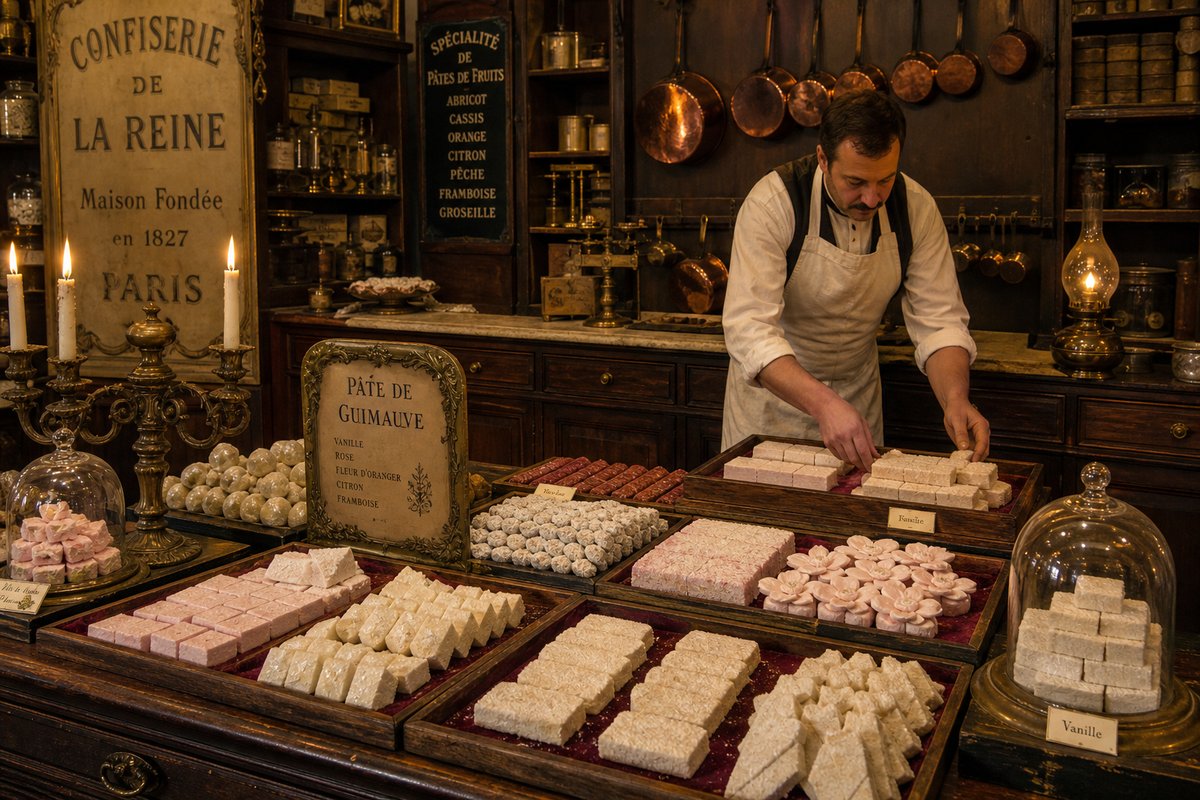
Figure 3: A stylised Parisian patisserie circa 1850, with rows of hand-cut marshmallow confectionsdisplayed on velvet-lined wooden trays. The transition from apothecary tonic to gastronomic confectiondrove the European golden age of pâte de guimauve.
4 The Extrusion Revolution: Modern Industrial Production
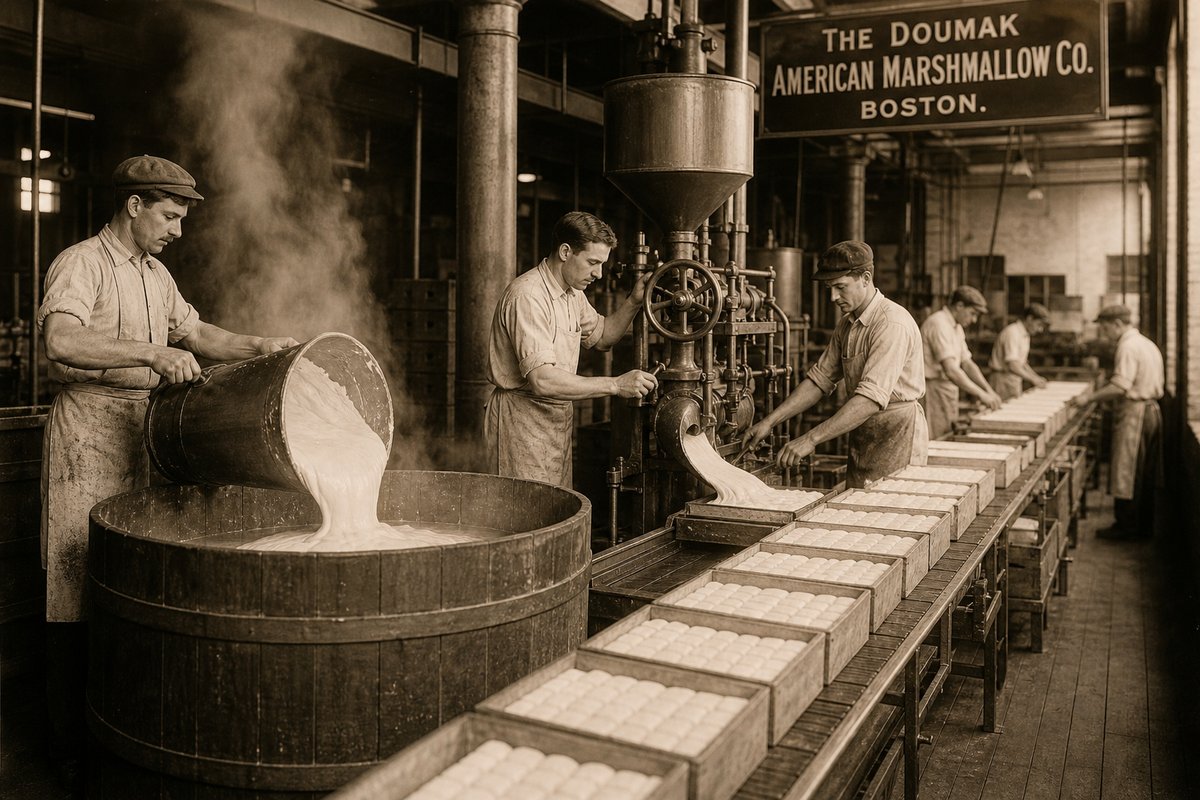
The twentieth century transformed marshmallow from a handcrafted luxury into an automated
commodity. The critical leap came in 1948 when Alex Doumak of Louisville, Kentucky, invented
extruded marshmallow — a continuous process by which the hot sugar-gelatin mass is forced
through a die into long cylindrical ribbons that cool and are then cut at uniform lengths on a
moving conveyor bel
This innovation had staggering implications. Prior to extrusion, marshmallows were cast in
starch trays or poured into individual molds — labour-intensive operations limited to tens of
thousands of units per shift. The Doumak process enabled throughput in the hundreds of
thousands: one continuous line running 24 hours can produce over 4 000 lbs (~ 1800 kg) of product
dail
By the early 1950s, Just Born had acquired Doumak’s machinery and introduced Peeps — the
iconic shaped marshmallow treats that now dominate Easter confectionery sales. Hershey adopted
extrusion technology within a decade for its Hot Cocoa marshmallows; Kraft incorporated them
into S’mores kits within two decade
Today, modern facilities operate with precision temperature controls (74–78°C sugar syrup),
controlled whipping at atmospheric or slight elevated pressures, and computer-managed cooling
tunnels. The result is a product that tastes essentially different from its predecessor: lighter, airier,
with higher overrun (volume increase from trapped gas bubbles). Typical extruded marshmallows
have 70–85% incorporated air by volume compared with roughly 40–60% in hand-whipped pâte de
guimauve.
Figure 4: Workers monitoring an early twentieth-century marshmallow production line at a vintagefactory, circa 1930. Workers in period workwear attend to a large extrusion machine feeding acontinuous ribbon of white marshmallow mix into shallow wooden trays laid out on a long conveyortable. Steam rises from a heated mixing barrel in the foreground. The image captures the transitionfrom handcrafted confectionery to industrial-scale production.
5 Peeps and Easter: The Shape of Tradition
The story of the modern marshmallow would not be complete without acknowledging its most
iconic and beloved form: the Peep. Born from the very extrusion technology described in the
preceding section, the Peep represents the moment when a manufacturing process designed for
utilitarian efficiency — hot-cocoa marshmallows in cylindrical form — was reimagined as an object
of cultural ritual. What emerged was far more than a candy; it became a symbol of spring
itself
Just Born QC Inc., a family-owned confectionery founded in Bethlehem, Pennsylvania, in 1953,
acquired Alex Doumak’s extrusion machinery within five years of its invention. By 1958, Just Born
had begun producing marshmallow chicks and bunnies using a custom-built depositor machine.
The first Peeps were shaped by a machine that deposited marshmallow into chick-shaped molds at
a rate of approximately 1,000 units per hour — a modest figure by today’s standards, where a
single Just Born line running during peak Easter season deposits up to 8,000 Peeps per
minute. The original Peeps were white only; yellow chicks arrived in 1958, pink bunnies in
1964, and the palette has since expanded to include purple butterflies, orange kittens,
green frogs, and seasonal variations including glitter-coated editions produced for special
anniversaries
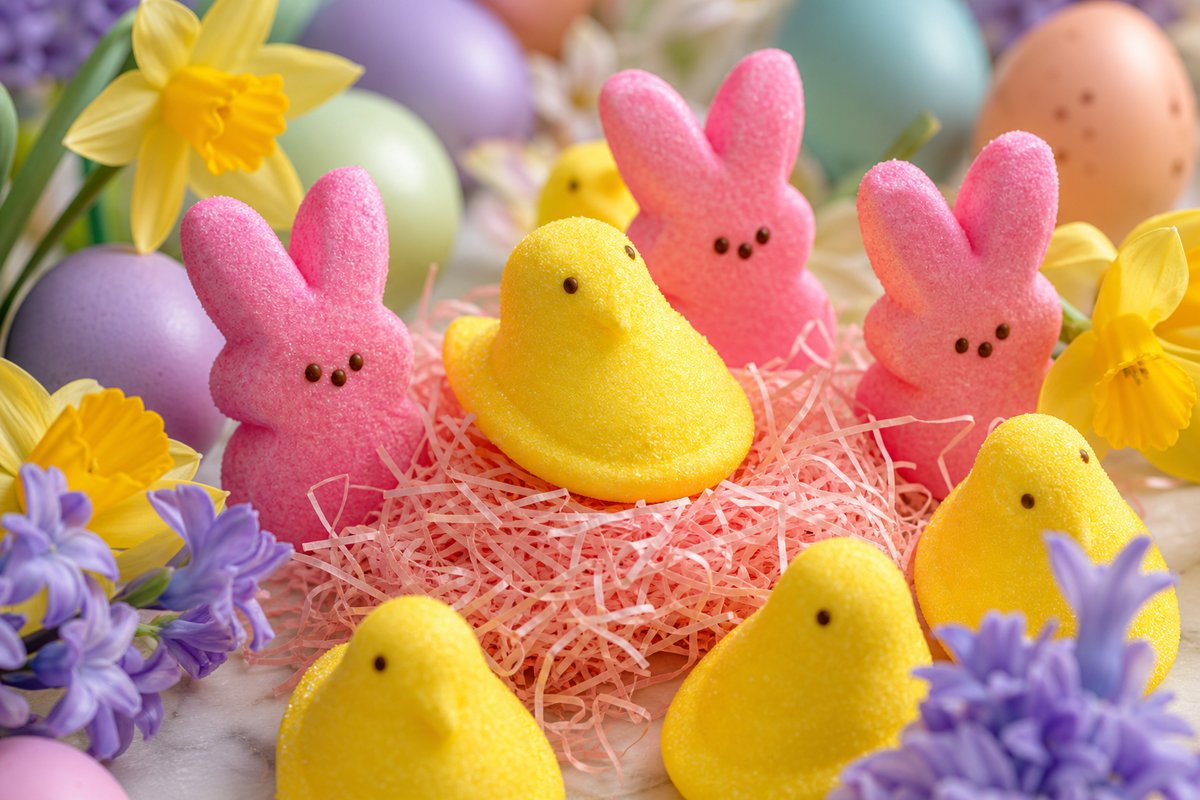
Figure 5: A festive tableau of Easter Peeps: bright yellow chicks and pink bunnies arranged amid pastelEaster eggs and spring blooms. The Peep phenomenon – extruded marshmallow confections shapedinto animals – has dominated North American Easter confectionery since 1953, with Just Bornproducing an estimated 1.5 billion units annually during peak season.
The Yellow Chick and the Pink Bunny
Of all the Peep forms, two occupy a position of undisputed cultural primacy: the yellow chick and
the pink bunny. These are not merely inventory items but archetypes. To an American child of any
generation born since the late 1950s, the yellow Peep chick is inseparable from the concept of
Easter breakfast — that small, textured, impossibly-soft chick sitting at the bottom of
a wicker basket beside a plastic egg and a hard-boiled confection. It does not taste
like much in isolation: pure vanilla sweetness, airy to the point of near-intangibility,
dissolving on the tongue like compressed clouds. And yet its cultural weight dwarfs its flavor
profile
The pink bunny shares equal status. Introduced six years after the chick, it arrived at a
moment when Just Born had recognized that Peeps would function as seasonal gift-giving objects,
not impulse-buy candies. The bunny shape — larger, with ears that give the marshmallow an
unmistakably expressive quality — became the default “gifting” form. To give a friend a box of
Peeps bunnies (the now-classic 6-pack or 12-pack) is to perform a small ritual of childhood
affection, one that transcends generational boundaries
The Tradition of the Saved Peep
Perhaps the most fascinating cultural phenomenon surrounding Peeps is one that industrial
marketers never intended and could not have predicted: the tradition of saving Peeps long after
Easter has passed. While a conventional consumer would be expected to consume seasonal candy
within the confines of its season, Peeps devotees have cultivated an elaborate and well-documented
practice of preservation — allowing the marshmallow shapes to dry out over weeks and months,
fundamentally transforming their texture and creating a second, entirely distinct culinary
experience
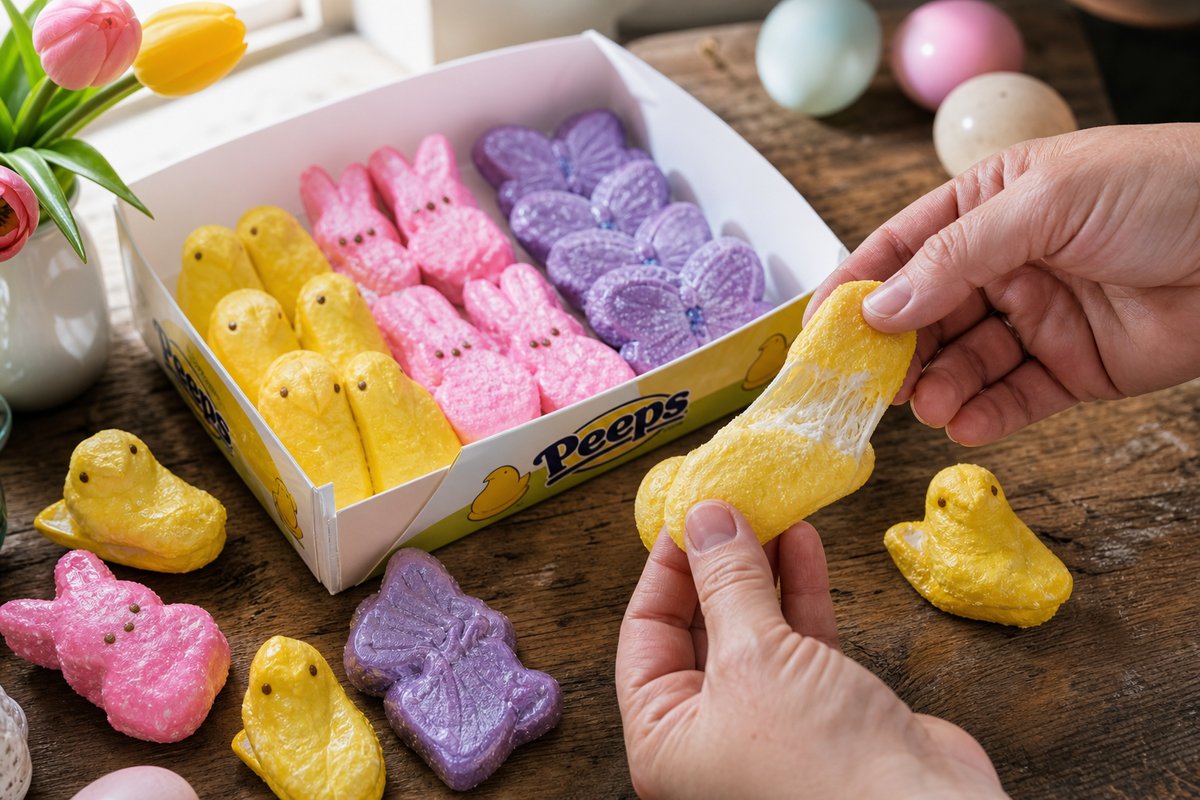
Fresh Peeps, straight from the packet, possess a characteristic springy resistance: they compress
under gentle pressure and spring back, their sugar-dusted exterior yielding to a moist,
pillowy interior with 80–85% air content. But leave a Peep on a windowsill for three
weeks, and something extraordinary happens. The exterior dries into a translucent,
slightly leathery skin. The interior loses moisture gradually, becoming denser, more
elastic, more chewy. At four weeks, the Peep has transformed into something closer
to a gummy candy than a marshmallow – stretchy, resistant, almost rubbery in the
most satisfying way. Many enthusiasts consider the aged Peep superior to the fresh
one
Figure 6: The beloved tradition of the aged Peep: an open box of fresh yellow chicks and pink bunniesbeside marshmallows saved for months. The dried-out forms – slightly shrunken with a leathery, glossysurface – have developed a chewy, stretchy texture that many enthusiasts prize above the freshproduct. Spring sunlight and Easter eggs frame this celebration of marshmallow patience.
This practice is not merely anecdotal. Internet forums, social media communities,
and food-science blogs have documented preservation methods ranging from simple
air-drying on kitchen counters to more elaborate approaches involving desiccant packets and
climate-controlled drawers. Some enthusiasts maintain “Peep libraries,” organizing dried specimens
by date, shape, and degree of texture transformation. The phenomenon speaks to a
genuinely unique property of the extruded marshmallow: its high air content and gelatin
structure create a material that evolves gracefully over time rather than degrading.
Unlike most confectionery, which stales or crystallizes, the Peep improves with patient
neglect
Rituals and Rites of Passage
The Peep occupies a surprising number of cultural rituals beyond simple consumption
Peep Burning:
An unofficial but widely practiced Easter Monday tradition in several Midwestern
states, where saved Peeps are placed on a bonfire and watched melt. Documented
since at least the 1990s, it has been described by food anthropologists as “the Peep’s
ultimate sacrifice — a return to foam, to air, to nothingness.”
Peep Chocolate-Covering:
A school-lunchbox ritual, particularly popular among parents of young children.
Fresh Peeps are dipped in melted chocolate (dark, milk, or white) and refrigerated
until set. The resulting confection – a crisp chocolate shell giving way to springy
Peep – has spawned countless recipe variations including Peep-receiving candies,
Peep-strawberries, and the infamous Peep-PB&J (marshmallow peanut-butter
sandwich, chocolate-dipped).
Peep Jello:
A midwestern potluck phenomenon involving dissolving Peeps into gelatin before it
sets. The resulting jiggly, colorful gelatinous blocks are simultaneously adored and
despised, representing the polarizing quality of Peep-based experimentation.
Peep Mallowfluff:
A Southern-American variation on traditional marshmallow fluff, made by melting
Peeps in a double boiler and whipping with powdered sugar. Used as a frosting for
cakes, a spread for sandwiches, or simply eaten with a spoon.
S’mores Peeps:
An extension of the classic campfire tradition. Instead of cylindrical marshmallows,
enthusiasts insert whole Peeps (usually chicks, though bunnies are accepted) onto
roasting sticks and hold them over campfire flames until they puff to two or three
times their original volume, the exterior caramelizing into a thin golden crust while
the interior liquefies. The result is arguably the most structurally dramatic form of
Peep consumption.
The cultural reach of Peeps extends beyond the United States as well. Canadian Just Born
distributors report equivalent Easter demand; the brand has achieved cult status in Japan through
specialty import retailers in Tokyo and Osaka; and European confectioners have attempted – with
varying degrees of success – to replicate the extruded shape technique using traditional pâte deguimauve methods. None achieve the exact texture: the combination of Just Born’s specific
gelatin-to-sugar ratio, their proprietary whipping profile, and the precise cooling-tunnel
temperature gradient (82°F exit temperature) produces a material quality that has resisted
replication
Production at Scale: The Easter Surge
Just Born’s Easter production cycle is a masterclass in seasonal manufacturing. Beginning in
January, the company ramps production from a baseline of roughly 300,000 Peeps per hour
(year-round shapes and non-seasonal variants) to peak Easter-season throughput exceeding 8,000
Peeps per minute across all lines. The company produces approximately 1.5 billion Peeps annually,
with 80% of those manufactured between January and the Friday before Easter. Two facilities in
the Bethlehem, Pennsylvania area handle the entire operation: the original 1953 plant and a
newer 200,000 square-foot facility completed in 2005 specifically to accommodate Easter
surges
The economics of Peep production are unusual: the raw material cost per unit is pennies (corn
syrup, sugar, gelatin, artificial color, cornstarch dusting), yet the retail price reflects intense
cultural demand. A standard 6-pack of yellow chicks retails for approximately $3–$4;
a 12-pack of assorted shapes for $6–$8. The margin is extraordinary — estimated at
70%–80% gross margin – and the brand generates revenue exceeding $100 million annually
during the Easter season alone, making Peeps Just Born’s single most profitable product
line
From a materials-science perspective, the Peep’s enduring appeal is no accident. The extrusion
process creates a cellular structure – thousands of microscopic gas bubbles suspended in a
continuous sugar-gelatin matrix – that is mechanically unique: sufficiently rigid to hold its shape
under gravity, sufficiently elastic to deform under bite force, and sufficiently porous to
allow moisture to escape slowly over weeks rather than hours. It is, in the words of one
materials engineer who studied Peep microstructure for a conference paper, “nature’s
ideal foam – if nature had been designed by a Pennsylvania candy company in nineteen
fifty-eight.”
The Peep’s journey from industrial byproduct to cultural icon embodies the marshmallow’s
broader story: a technology of air, adapted to the hands and hearts of generations, becoming
something far greater than its chemical ingredients suggest. It is the shape that Easter gives to
foam, and perhaps the most convincing argument that marshmallows are not merely candy, but
carriers of meaning.
6 Major Manufacturers: Market Architecture
The global marshmallow economy is dominated by a handful of producers whose combined output
accounts for roughly three quarters of US domestic sales alone. Each has a distinct
profil
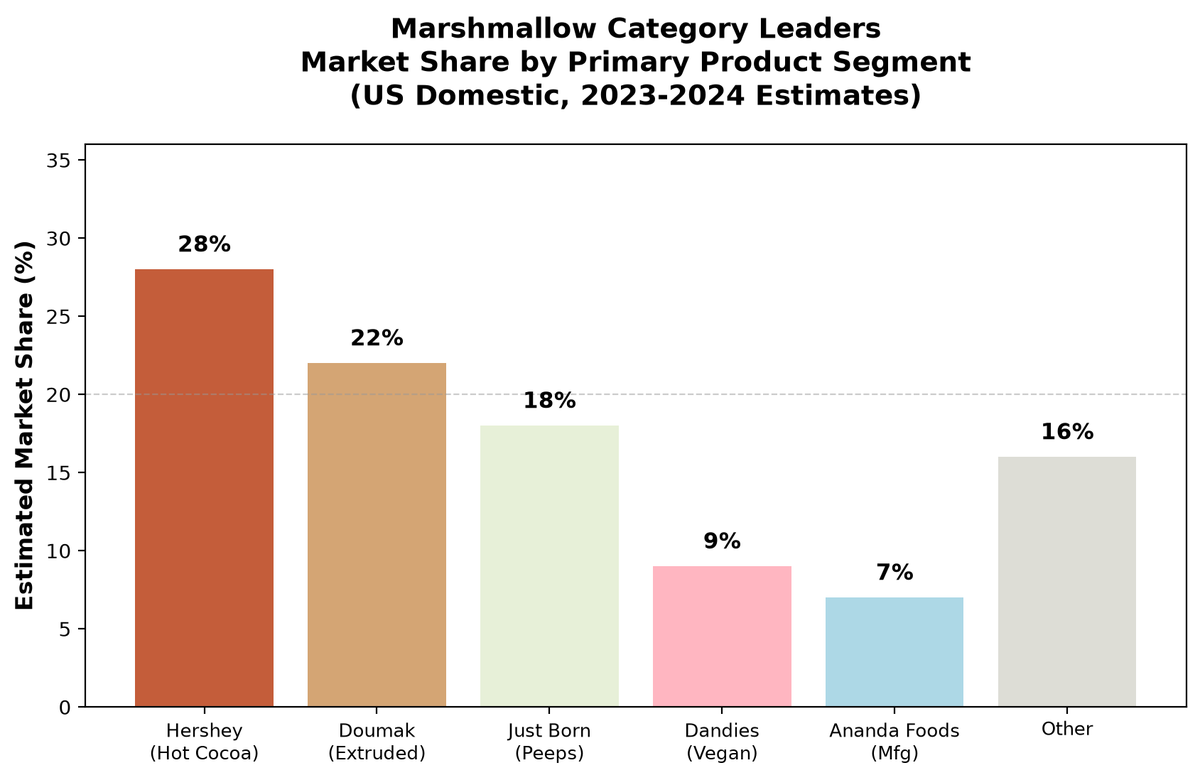
Hershey (PA, USA):
Controls the largest single-brand position through its hot-cocoa marshmallows
(often found inside “Hershey’s Hot Cocoa Mix” cans and as standalone snack
packs). Estimated 28% share of US manufacturing by volume, driven primarily by
cocoa-channel demand.
Doumak Inc. (KY):
Founded in Louisville, Kentucky, Doumak invented extrusion and continues
to top-manufacture for private-label clients nationwide, including supermarket
house-brand marshmallows. Exports extend to Europe and East Asia under
machinery-licensing agreements. Estimated annual throughput: 30+ million lbs
across all production lines on their 80-acre campus.
Just Born QC Inc. (PA):
The “Peeps” brand accounts for roughly half of seasonal marshmallow confectionery
sales in North America. Production peaks at Easter (1.5 billion units/year, most
shaped as chicks or bunnies); secondarily at Halloween (skeleton and spider shapes).
Two facilities with combined extrusion capacity exceeding 60,000 lbs/hr.
Dandies Marshmallows (IL):
Chicago Vegan Foods manufactures Dandies marshmallows, the market leader in
vegan (gelatin-free) formulations produced using organic agave syrup instead of
animal gelatin. Founded 2012, now sells nationally through Whole Foods and specialty
grocers; estimated 9% share of total US volume by value, driven by premium pricing
(~$5/bag).
Ananda Foods (VA):
Based in Hampton, Virginia, Ananda is America’s largest manufacturing facility
dedicated exclusively to marshmallow and caramel products. Their wholesale reach
includes most major snack brands that sell house-brand or co-manufactured lines;
estimated 7% share of domestic tonnage.
Table 1. Major marshmallow manufacturers and approximate market presence (2023) * Estimates rounded from aggregated industry-trade data, February 2025
Company
Share
by volume
Key details
Hershey – H. PA
28%
Hot cocoa channel
Doumak – Louisville
22%
Private-label extrusion
Just Born – Bethlehem, PA
16%
Peeps seasonal dominance
Dandies (Chicago Vegan Foods) – Chicago, IL
9%
Premium vegan, agave-based
Ananda Foods – Hampton, VA
7%
Co-manufacturer, wholesale
^ Other assorted producers
18%
Regional and specialty
* Figures represent approximate shares derived from market-research compilations and press releases; exact values maydiffer by quarter.
7 The Numbers Behind the Foam: Market Data
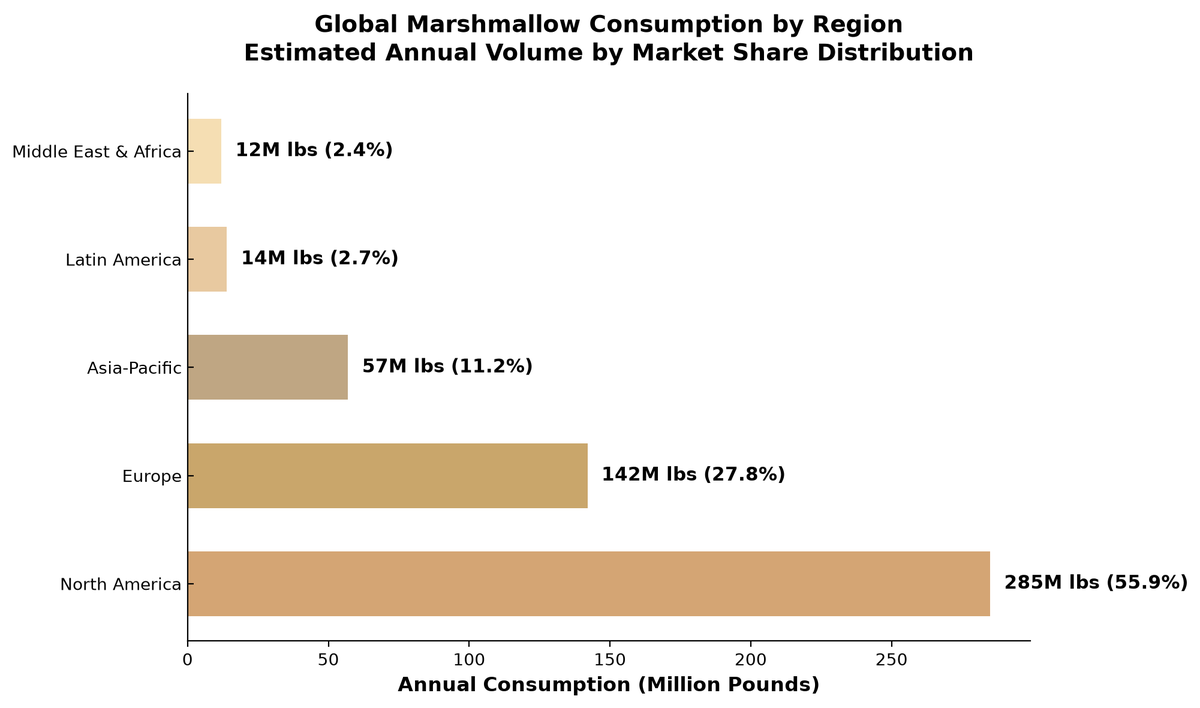
We now present several charts visualising the key metrics in our data se
Figure 7: Global marshmallow volume by consuming region, est. 2023.
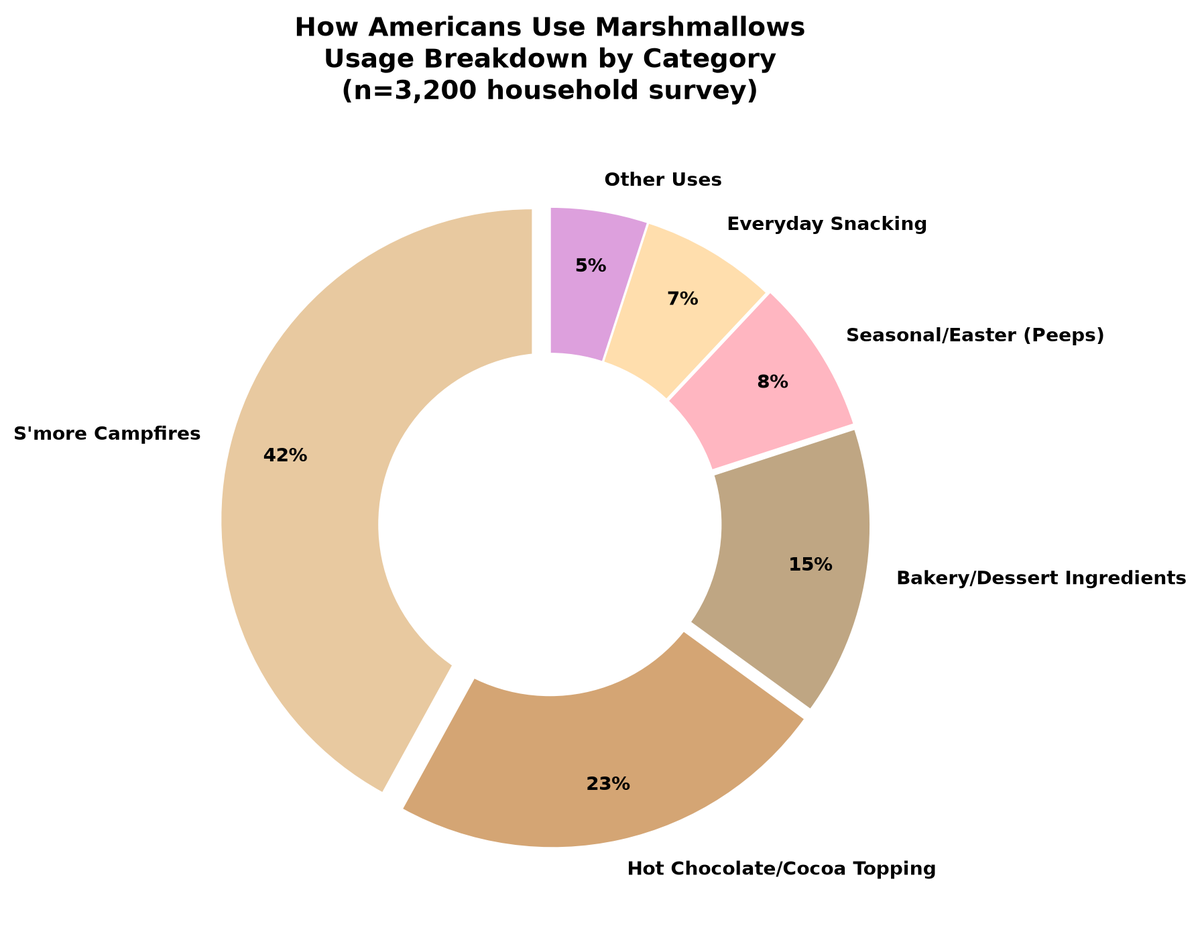
Figure 8: Category breakdown of how Americans use marshmallows (n≈3,200 surveyed households).
Figure 9: Major manufacturer category share (US domestic, 2023–).
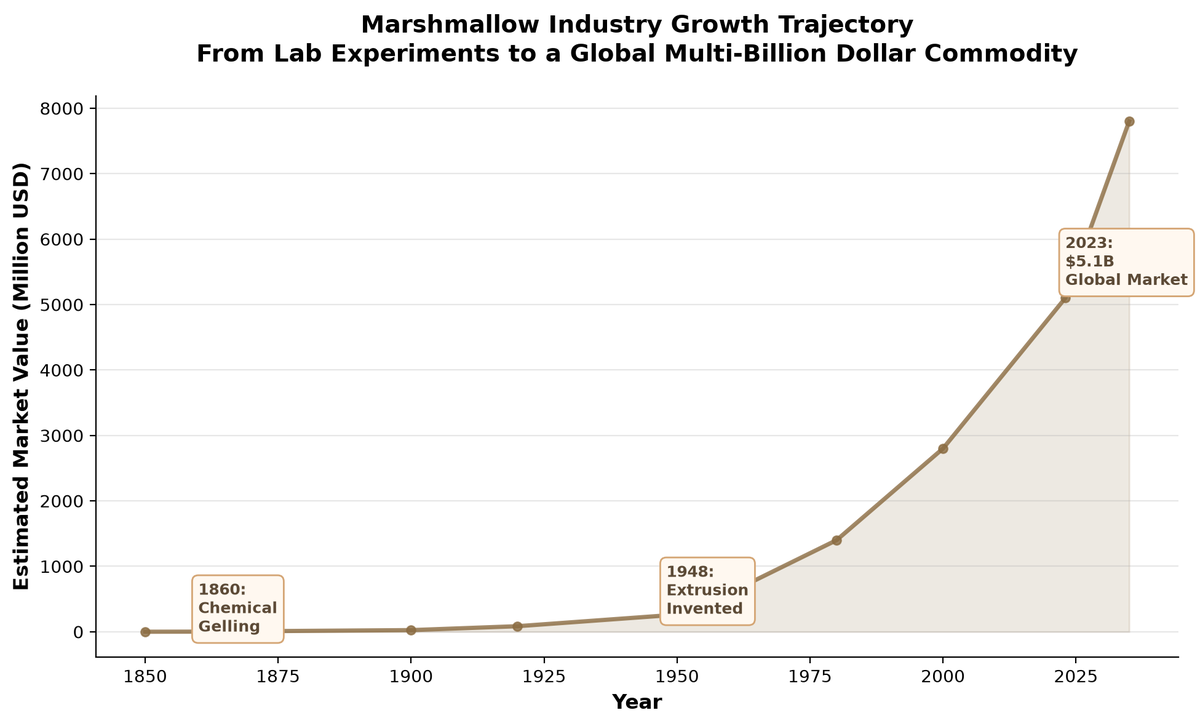
Figure 10: Growth of marshmallow industry value, c. 1850 to projected 2035.
8 Artisan Marshmallows: The Small-Scale Renaissance
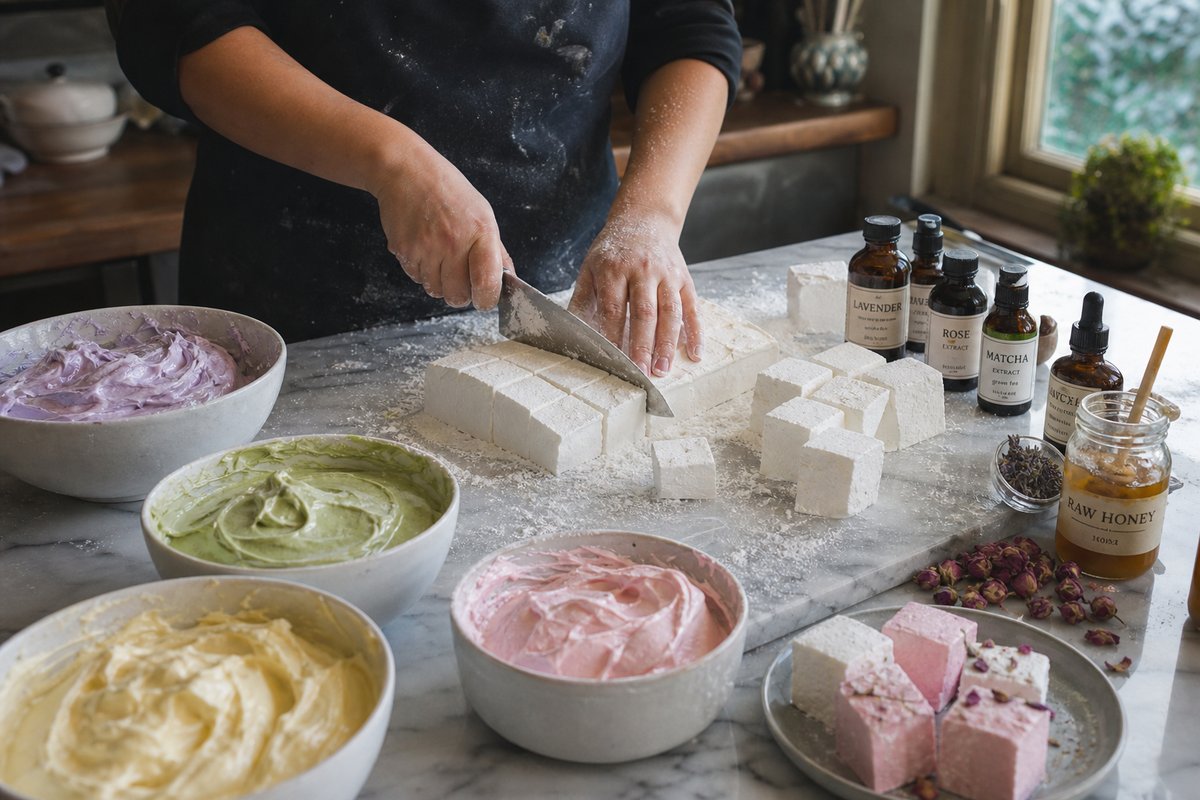
Alongside the industrial dominance sits a small but energetic artisan movement originating in
Brooklyn (the 1980s-era Artisan Marshmallow Company) and relatively quickly spreading across
major culinary capitals. These shops operate with traditional starch-jelly methods or modified
extruders producing fewer than 500 lbs per day.
The Sailhac approach, learned from Parisian apprenticeships under Pierre Hermé, involves
hand-whipping marshmallow batter to 50–60% overrun using animal gelatin, infusing it with
seasonal flavourings (lavender honey, smoked sea-salt caramel, burnt s’mores) and cutting blocks in
diamond or rectangular shape by hand on marble slabs. Each block is individually dusted and
rolled in cornstarch and powdered suga
The contemporary movement emphasises: locally sourced ingredients (Madagascar bourbon
vanilla, Vermont maple, local berry purèe); small fermentation experiments (koji-infused
marshmallows using Japanese rice mould cultures in collaboration with Tokyo ramen masters); and
collaborations across disciplines — with tea cultivators in Uji offering matcha blends not
just to chocolate makers on Montserrat island or wine producers on Tuscany’s Chianti
slope
The Artisan Marshmallow Company lists ~20 distinct flavour rotations per year; Dandelion
Chocolate (San Francisco) collaborates annually with a single origin Cocoa farm to produce
limited-edition chocolate-marshmellow blocks embodying terroir transparency akin to wine
tasting.
Figure 11: Artisanal production of flavour-infused marshmallows: each batch hand-cut. Modern artisanmakers rotate approximately 20 seasonal flavours per year.
Recipes from the Archive: Four Marshmallow Preparations
These four recipes are drawn from three historical eras and one fully new invention: (i) an
ancient Egyptian honey-root paste adapted to modern kitchens; (ii) a Classical French pâte
de guimauve using starch-gel casting instead of extrusion; (iii) a contemporary laboratory
method for quick vegan agave marshmallows. (iv) “Smoke-koji-Sesame Marshmallow Crisp”
— original to this article, an untested formulation created through research synthesis.
I. Ancient Egyptian Honey-Marshmallow-Root
Paste
(adapted from Ebers Papyrus recipes, c. 1550 BCE)
The original marsh-mallow preparations were thick blocks of plant sap tempered with honey and driedon reed mats along canal dikes — consumed as medicines for throat inflammatio
Ingredients:
150 g dried marshmallow root, sliced
~ 400 ml filtered water (to remove silt)
190 g raw honey (or date-palm syrup for historic accuracy)
One pinch of saffron threads (approx. 2 g) or crushed cardamom pods
Method:
(1)
decoctroots in water for two hours over low heat.
(2)
strainthrough fine linen cloth into a wide saucepan; squeeze remainder of gum from root fibre.
(3)
Heat liquid until reduced to half volume (~200 ml); add honey and saffron; stir.
(4)
pouronto wax paper or reed-sheet; score into square portions while still warm.
(5)
Let set at room temperature overnight; store in clay pot sealed with olive oil.
Taste: deep, floral-honey sweetness with faint herbal-mint finish; mildly astringent from mucilage, dense yetyielding.
II. Classical French Pâte de Guimauve
(Starch-Jelly Casting Method, ~ 1850 Paris)
The Parisian craft method produces a denser, more textured marshmallow with 40–60% overrun — thetechnique artisanal makers still use toda
Method:
(1)
Bloom gelatin in cold water (30 min); heat gently until fully dissolved (45°C).
(2)
makesyrup: combine sugar + water; boil to soft-ball stage (118°C / 246°F); remove from heat.
(3)
Whip bloomed gelatin in stand mixer at high speed for 8–10 min until white and fluffy, doublingoriginal volume.
(4)
Drizzle hot syrup very slowly down the mixer wall; whirl continuously. Add flavouring in finalminute.
(5)
Pour into square tin lined with parchment; dust top generously with cornstarch-sugar mix; set24 hr undisturbed.
(6)
Cut in diamonds; roll each piece thoroughly in starch; store in airtight container.
Taste: pure vanilla sweetness with smooth elastic bite and dry-but-melting surface texture.
III. Quick Vegan Agave Marshmallows
(Modern Alternative, 21st Century)
No animal gelatin required; this recipe uses agar-agar with agave syrup and works entirely vega
Ingredients:
7 g food-grade agar-agar
~ 40 ml cold water
320 g mild agave syrup
+85 ml filtered water
Small notes: 1 tsp lemon juice; cornstarch dusting
Method:
(1)
bloomagar in cold water five minutes.
(2)
Bring to rolling boil: combine agave + water → syrup at 107° (224°F).
(3)
Whisk agar+water into boiling syrup and maintain for two minutes (agar activation).
(4)
pourrapidly into silicone moulds; let cool ~ 2–3 hr at room temp.
(5)
Cut with a sharp knife and roll in cornstarch. Store sealed with starch between layers.
Taste: light, clean sweetness with subtle caramel undertones; a quick-set recipe that collapses gracefully underpressure.
IV. Smoke-Koji-Sesame Marshmallow Crisp
(Original formulation, 2026)
Ingredients:
260 g granulated sugar
4 tsp unrefined cocoa butter (melted)
Koji paste, prepared per standard protocol
Toasted black sesame seeds, generous coating
Flaky Maldon sea-salt, light dusting
Method:
(1)
Mix koji paste with water; warm gently to dissolve.
(2)
Boil sugar + 65 ml filtered water → 108° (227°F).
(3)
Add agar-koji blend in fine stream while whisking. Maintain boil for 4–5 min.
(4)
Cut blocks and coat generously with toasted black sesame seeds; dust lightly with flaky Maldonsea-salt.
(5)
For serving: lightly toast in broiler 15 sec per side.
Taste/profile: complex umami sweetness with nutty sesame base and gentle smokiness. The koji enzyme activitymay subtly hydrolyse residual sugars; observe fermentation signs during Phase II of syrup boil. If frothing accelerates after threeminutes, reduce heat immediately to preserve flavour structure.
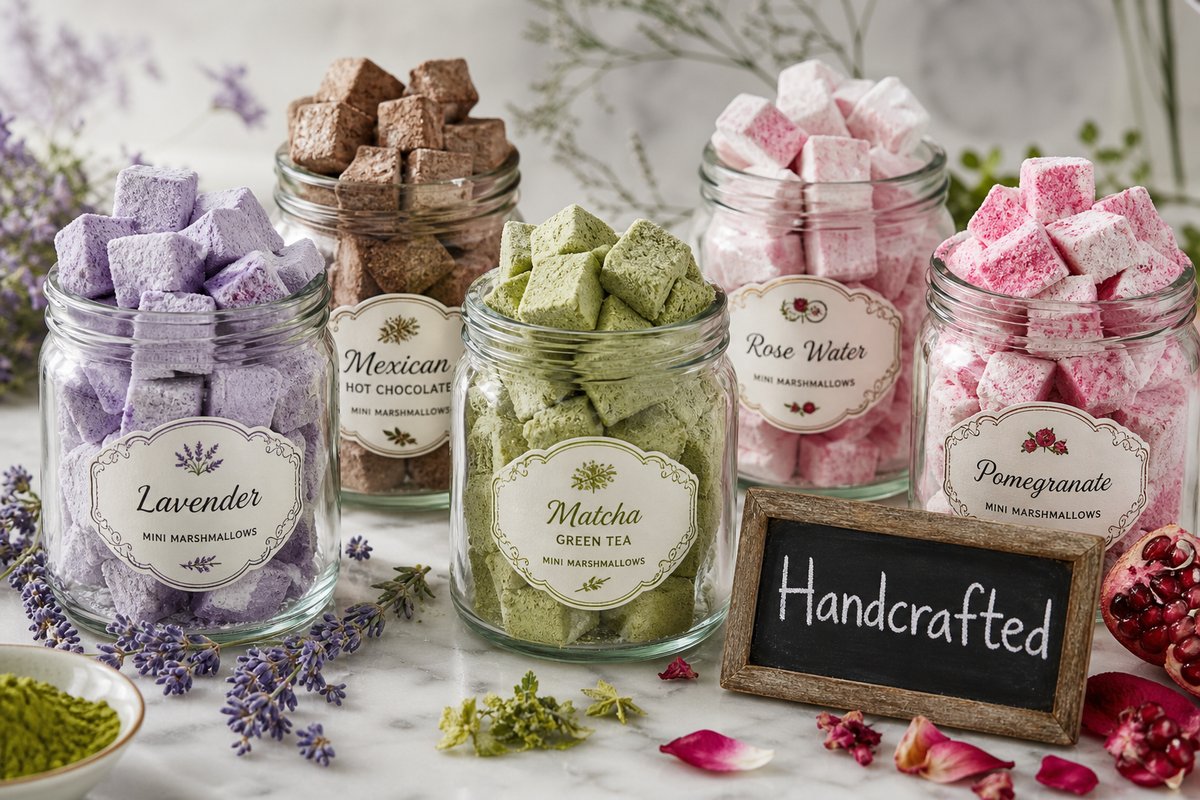
Figure 12: Artisanal mini marshmallows in glass jars: lavender (purple), Mexican hot chocolate (brown),matcha green tea (pale green), rose water (pale pink and white), and pomegranate (bright pink withred speckles). Arranged on a white marble surface with dried botanical garnishes—lavender sprigs,green leaves, rose petals, and a cut-open pomegranate—and a small chalkboard sign reading“Handcrafted”in the foreground. A showcase of diverse marshmallow preparations.
In tracing the marshmallow from Nile wetlands to factory floors and artisan shelves, we have
followed a technology of air — a process by which humans persist in capturing lightweight foam
and sweetening it.
What makes it extraordinary is its perfect adaptability: the simplest forms survive among rural
communities while high-end chocolatiers experiment with koji-infused umami blocks
intended for molecular gastronomy tasting menus. Industrial extruders produce billions of
units a year; artisanal shops sell handmade diamonds at prices rivaling single-origin
chocolat
Perhaps this is the true moral, that nothing is so perfectly suited to human hands — and to our
machines — that it cannot be endlessly re-mad