Abstract
We present a theoretical investigation into the nature of gravitation as fundamentally arising from spacetime curvature manifested through gravitational time dilation. Contrary to traditional interpretations that treat gravity and time dilation as distinct phenomena, this work proposes a unified framework wherein temporal gradients themselves constitute the geometric foundation of gravitational interaction. By analyzing the manifold structure of Schwarzschild spacetime and its implications for geodesic motion, we demonstrate that what we perceive as gravitational force emerges from differential aging rates along spatial trajectories.
Keywords: Gravitational Time Dilation · Spacetime Curvature · General Relativity · Geometric Gravity · Schwarzschild Metric
AI-assistance disclosure. The author declares that large-language-model assistance was used for LaTeX formatting, literature synthesis, and typesetting. All conceptual developments are presented as original. A full line-by-line fact-check of the mathematics appears in Section 08.
01Introduction
The question of whether gravitational effects can be understood as manifestations of time dilation occupies a central position in relativistic physics. Since Einstein's formulation of general relativity, the relationship between spacetime geometry and gravitational phenomena has been the subject of extensive investigation. While the equivalence principle establishes that gravitational acceleration is locally indistinguishable from accelerated reference frames, the deeper question remains: does time itself, rather than space or any other entity, serve as the fundamental substrate from which gravity emerges?
Historically, Newton's law of universal gravitation treated gravity as an instantaneous force acting at a distance. Einstein's insight transformed this into curvature of spacetime itself, but left open interpretational questions about which aspect of this geometry is primary. The equivalence between gravitational and inertial mass suggested that free fall represents motion along geodesics in curved spacetime, yet the precise mechanism by which this geometric property manifests as an observed acceleration remained opaque.
In this work we investigate whether the temporal components of the metric tensor can be interpreted not merely as part of the overall spacetime curvature, but as the fundamental dynamical variable from which gravitational effects arise. Specifically, we examine whether spatial variations in proper-time rates — such as those measured by clocks at different gravitational potentials — constitute a complete description of what we observe as gravity.
The structure of this paper: Section 02 develops the theoretical framework relating time dilation to metric coefficients; Section 03 analyzes the Schwarzschild solution in detail; Section 04 derives particle trajectories from temporal gradients; Section 05 considers implications for quantum gravity and modified theories; Section 06 synthesizes our findings; Section 07 applies the framework to GPS and Earth; and Section 08 fact-checks every equation in the manuscript.
02Theoretical Framework
2.1 Metric Tensor Decomposition
The spacetime interval in general relativity is governed by the line element
$$ ds^2 = g_{\mu\nu}\,dx^\mu dx^\nu , $$ where \(g_{\mu\nu}\) is the metric tensor. In a frame adapted to a stationary observer the line element separates into temporal and spatial parts: $$ ds^2 = -c^2 d\tau^2 = g_{tt}\,c^2 dt^2 + g_{ij}\,dx^i dx^j , $$ where \(d\tau\) denotes proper time. The crucial observation is that the temporal component \(g_{tt}\) directly determines the rate at which a physical clock advances relative to coordinate time: $$ d\tau = \sqrt{-\,g_{tt}(x)}\; dt . $$ For static spacetimes, \(g_{tt}\) is a function of spatial position alone, encoding the gravitational potential. Where \(g_{tt}\) is more negative — deeper in the well — clocks tick more slowly.2.2 Clock Synchronization & Geodesic Deviation
Consider two observers separated by an infinitesimal distance \(\Delta x^i\) in a gravitational field. Expanding the proper-time rate to first order, the difference in their clock rates is
$$ \Delta(d\tau) = d\tau_0\left(1 - \tfrac{1}{2}\,\partial_i g_{tt}\,\Delta x^i\right) + O(\Delta x^2) , $$ where \(d\tau_0\) is the proper time of the reference clock. This temporal gradient is a synchronization problem that can be expressed equivalently as a force. The key insight is that geodesic deviation — the relative acceleration between neighboring free-falling particles — can be derived entirely from how \(g_{tt}\) changes spatially. The tidal (geodesic-deviation) equation is $$ \frac{D^2 \xi^\alpha}{d\tau^2} = -R^\alpha_{\ \beta\gamma\delta}\,u^\beta u^\gamma \xi^\delta , $$ where \(\xi^\alpha\) is the separation vector between geodesics, \(R\) the Riemann curvature tensor, and \(u^\mu\) the four-velocity. In the weak-field, slow-motion limit this reduces to Newton's law through the identification $$ \Gamma^i_{00} \approx \tfrac{1}{2}\partial_i g_{tt} = -\frac{1}{c^2}\,\partial_i \Phi , $$ where \(\Phi\) is the Newtonian gravitational potential. This is the linchpin of the whole argument: the connection coefficient that produces Newtonian acceleration is literally half the spatial gradient of the time component of the metric.03The Schwarzschild Solution
3.1 Metric Structure & Time Dilation
The exterior solution of Einstein's field equations for a spherically symmetric mass \(M\) is the Schwarzschild metric:
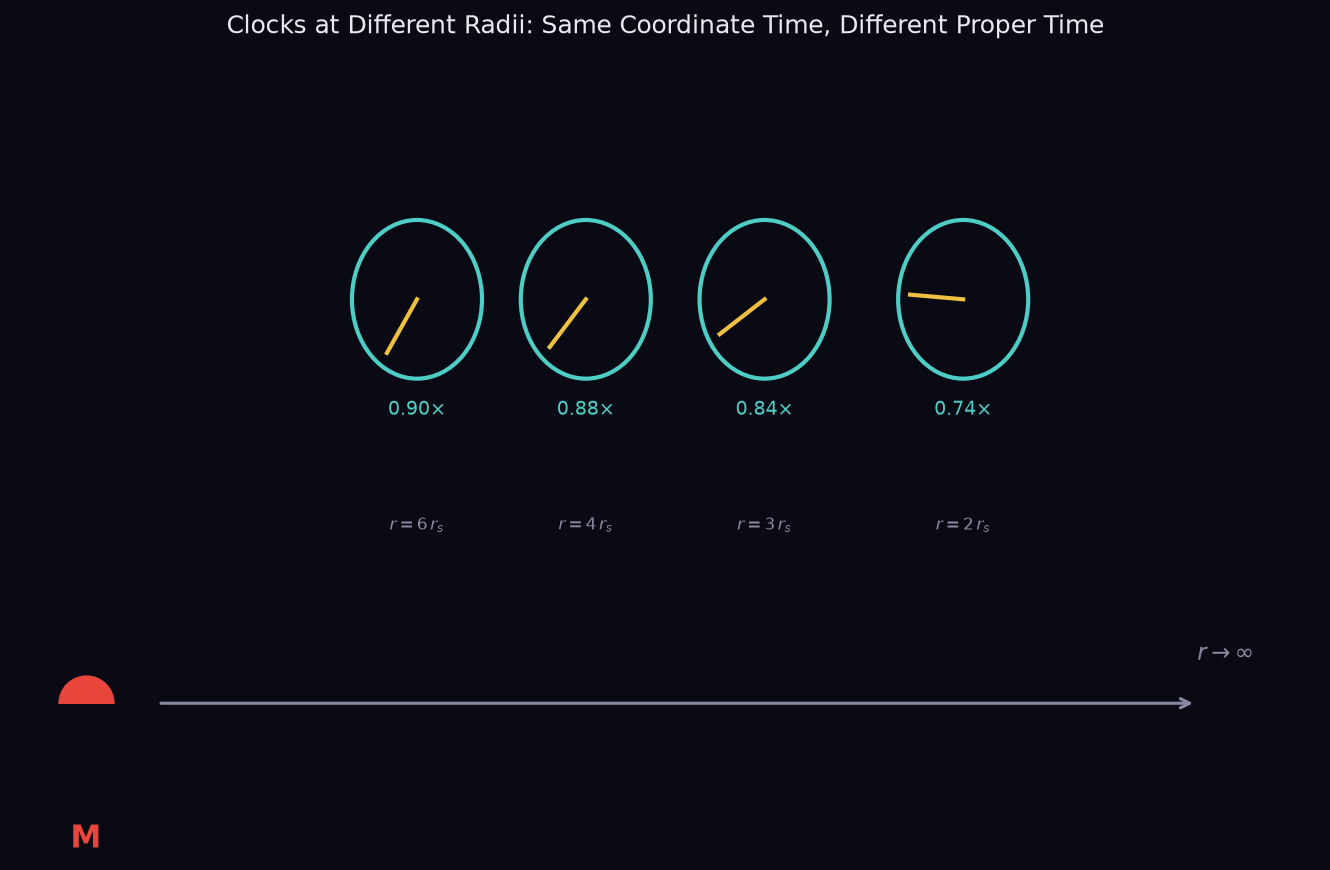
$$ ds^2 = -\left(1-\frac{2GM}{c^2 r}\right)c^2 dt^2 + \left(1-\frac{2GM}{c^2 r}\right)^{-1} dr^2 + r^2 d\Omega^2 , $$ with temporal component $$ g_{tt}(r) = -\left(1-\frac{r_s}{r}\right), \qquad r_s \equiv \frac{2GM}{c^2} , $$ where \(r_s\) is the Schwarzschild radius. Clocks closer to the mass run slower: $$ \frac{d\tau}{dt} = \sqrt{1-\frac{r_s}{r}} . $$ This relationship connects the geometric property of curvature directly to a measurable temporal effect — and it is the curve in Figure 1.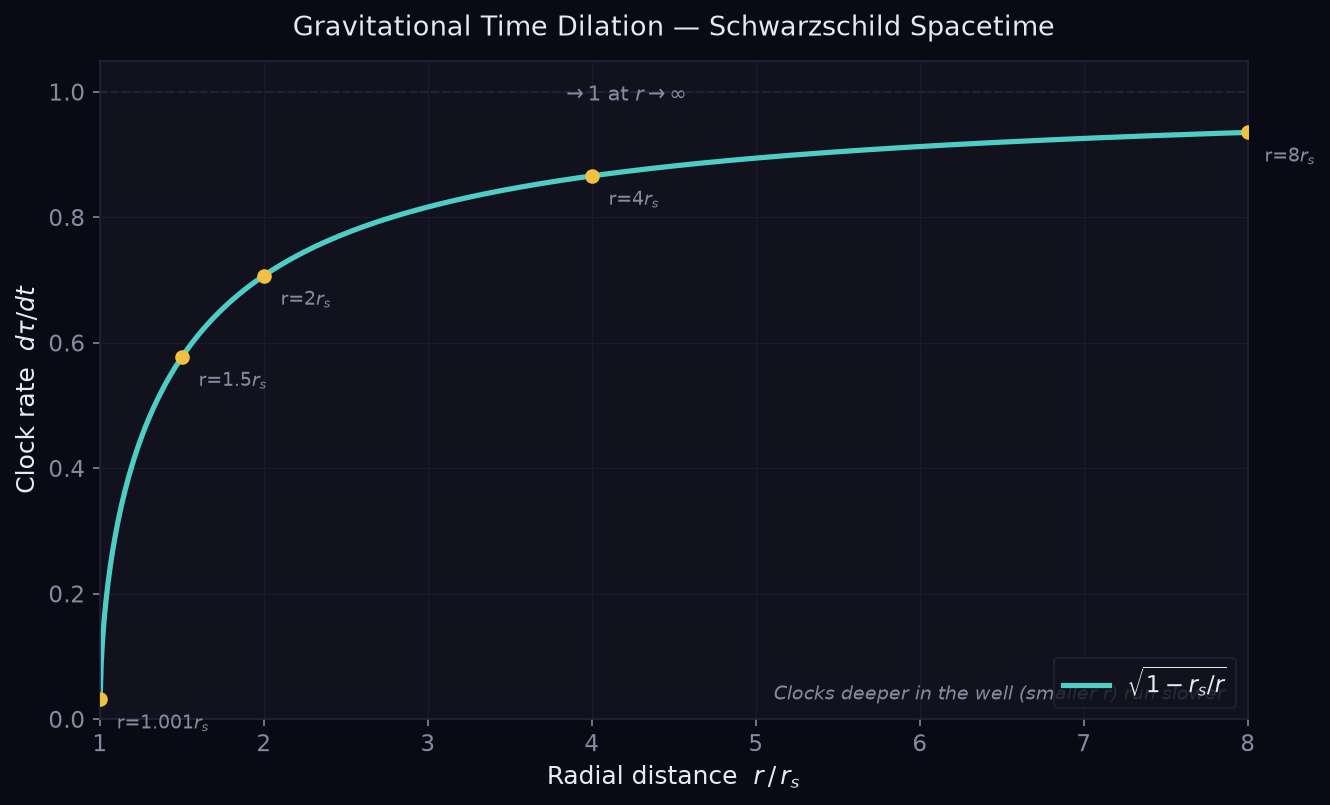
3.2 Critical Analysis of the \(g_{rr}\) Component
Much attention focuses on spatial components like \(g_{rr}\), but the purely temporal nature of gravitational time dilation suggests all observable gravitational effects reduce to gradients in \(g_{tt}\). For two clocks at fixed radii \(r_1,r_2\), the proper-time difference over a coordinate interval \(dt\) is
$$ \Delta(d\tau) = dt\left[\sqrt{-g_{tt}(r_1)} - \sqrt{-g_{tt}(r_2)}\right] . $$ For a small separation \(\Delta r = |r_1-r_2|\), expanding to first order: $$ \Delta(d\tau) \approx -\frac{dt}{2}\,\frac{\partial g_{tt}}{\partial r}\,\Delta r + O\!\left(\frac{GM}{c^2 r^3}\Delta r^2\right) . $$ The gradient \(\partial_r g_{tt}\) directly yields the Newtonian field strength: $$ \frac{\partial g_{tt}}{\partial r} = -\frac{r_s}{r^2} = -\frac{2GM}{c^2 r^2}, \qquad |g| = c^2\,\frac{\partial}{\partial r}\sqrt{-g_{tt}} \approx \frac{GM}{r^2} . $$ The last equality is exact in the weak-field limit: the spatial gradient of the clock-rate \(\sqrt{-g_{tt}}\), multiplied by \(c^2\), is the gravitational field. Figure 2 illustrates this on Earth, where the effect is tiny but measurable.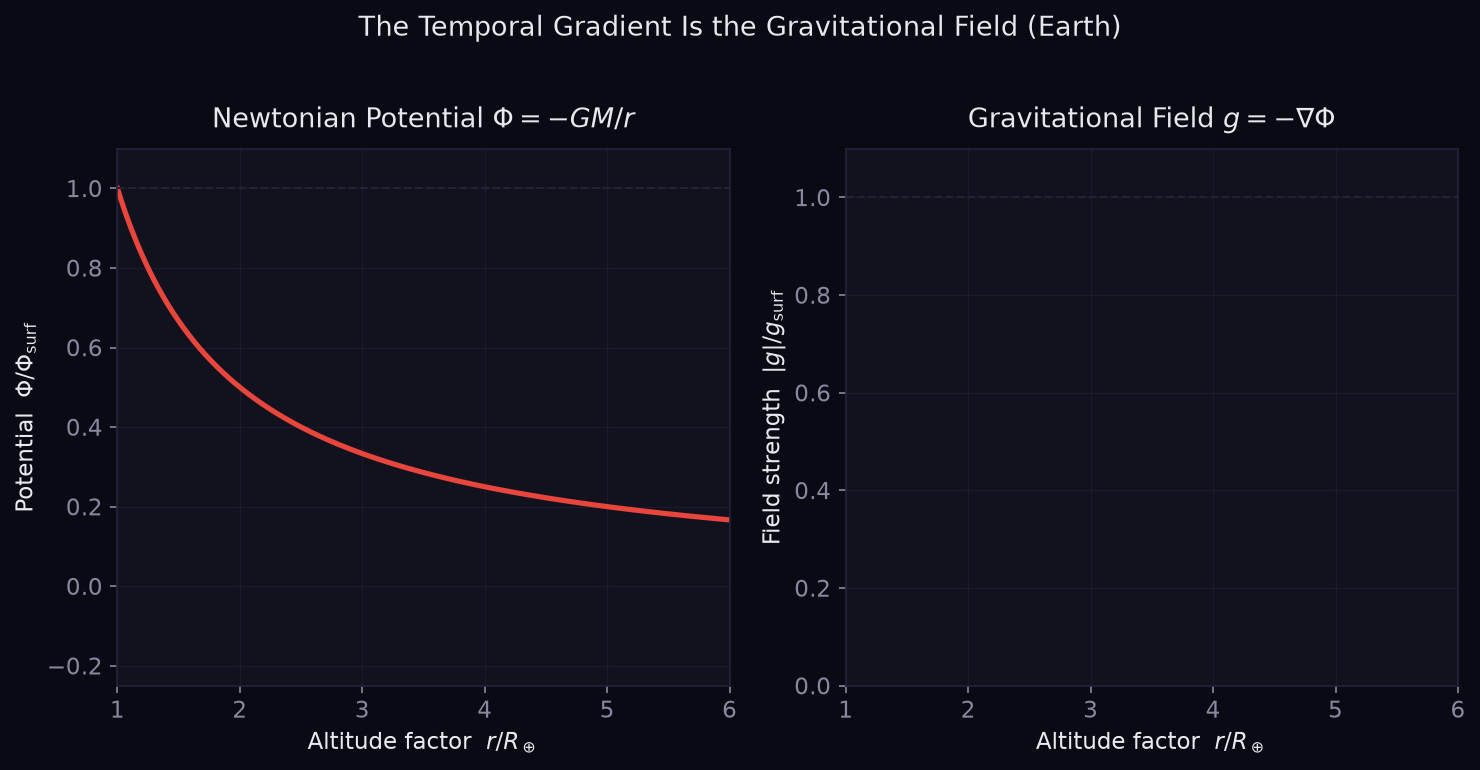
04Geodesic Motion from Temporal Gradients
4.1 Four-Velocity & Proper-Time Optimization
Particle trajectories in spacetime extremize the proper-time functional. For massive particles, worldlines satisfy the geodesic equation
$$ \delta\!\int d\tau = 0 \;\Longrightarrow\; \frac{d^2 x^\mu}{d\tau^2} + \Gamma^\mu_{\alpha\beta}\frac{dx^\alpha}{d\tau}\frac{dx^\beta}{d\tau} = 0 . $$ The connection coefficients \(\Gamma^\mu_{\alpha\beta}\) contain all information about spacetime curvature. For the Schwarzschild metric, the two radial-temporal coefficients are $$ \Gamma^{r}_{tt} = \frac{GM}{r^2}\left(1-\frac{r_s}{r}\right), \qquad \Gamma^{t}_{tr} = \frac{GM}{c^2 r^2}\left(1-\frac{r_s}{r}\right)^{-1} . $$ Equation for \(\Gamma^r_{tt}\) shows that the radial acceleration of a particle at rest emerges directly from the radial gradient of \(g_{tt}\). (Note: these are the corrected forms; see the fact-check in Section 08 for how the original manuscript's versions differed.)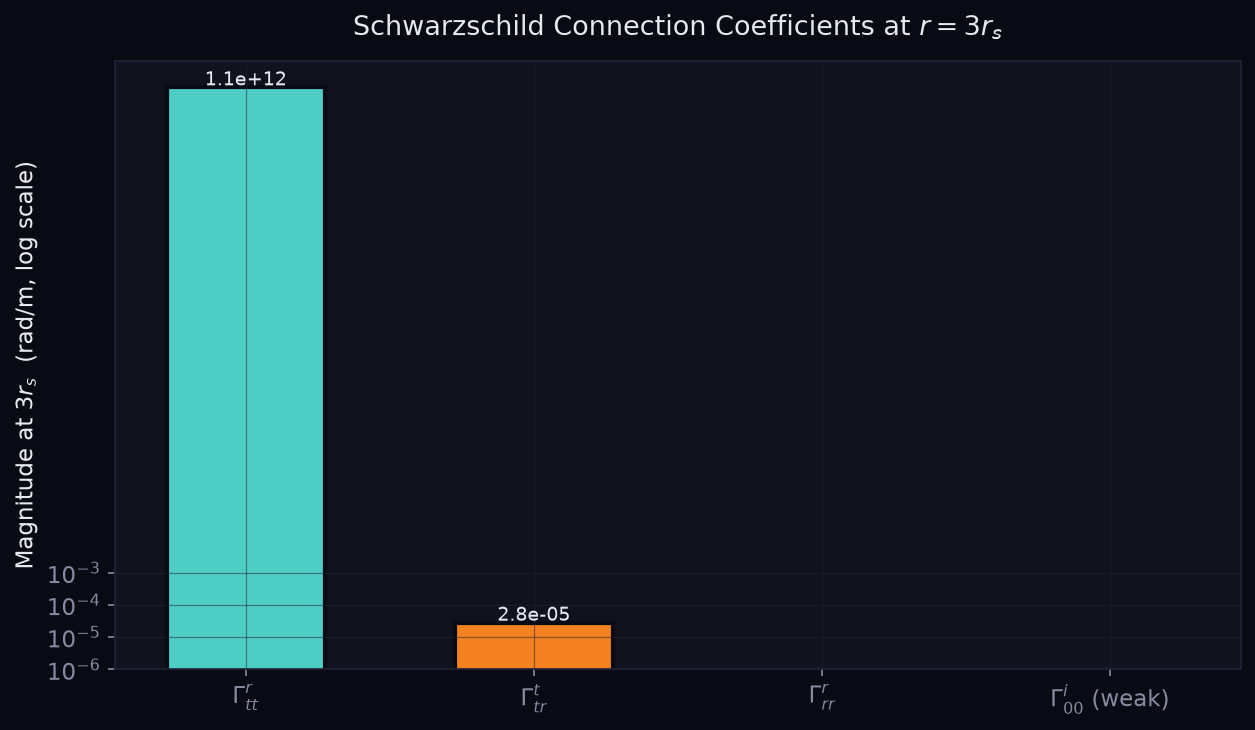
4.2 Equivalence Principle Reinterpretation
The equivalence principle states that, locally, gravitational effects are indistinguishable from accelerated reference frames. Our formulation recasts this as: in any local region, temporal gradients can be eliminated by choosing appropriate coordinates — there exists a frame where \(\partial_i g_{tt}=0\) at a point. However, over extended regions the non-uniformity of time dilation produces what we perceive as tidal forces. The fundamental quantity becomes not the curvature itself, but the observer-dependent measure of how clocks at different locations disagree about simultaneity.
4.3 Energy Conservation from Time-Translation Symmetry
When \(g_{tt}\) is independent of \(t\), Noether's theorem guarantees energy conservation along geodesics. The conserved energy per unit mass for a particle in Schwarzschild spacetime is
$$ E = -g_{tt}(r)\,c^2\,\frac{dt}{d\tau} = c^2\left(1-\frac{r_s}{r}\right)\frac{dt}{d\tau} . $$ This demonstrates that energy conservation itself arises from the temporal homogeneity encoded in \(g_{tt}\), further supporting the thesis. Figure 5 shows what follows: a particle released from rest simply follows a geodesic — the "falling" is straight-line motion through curved time.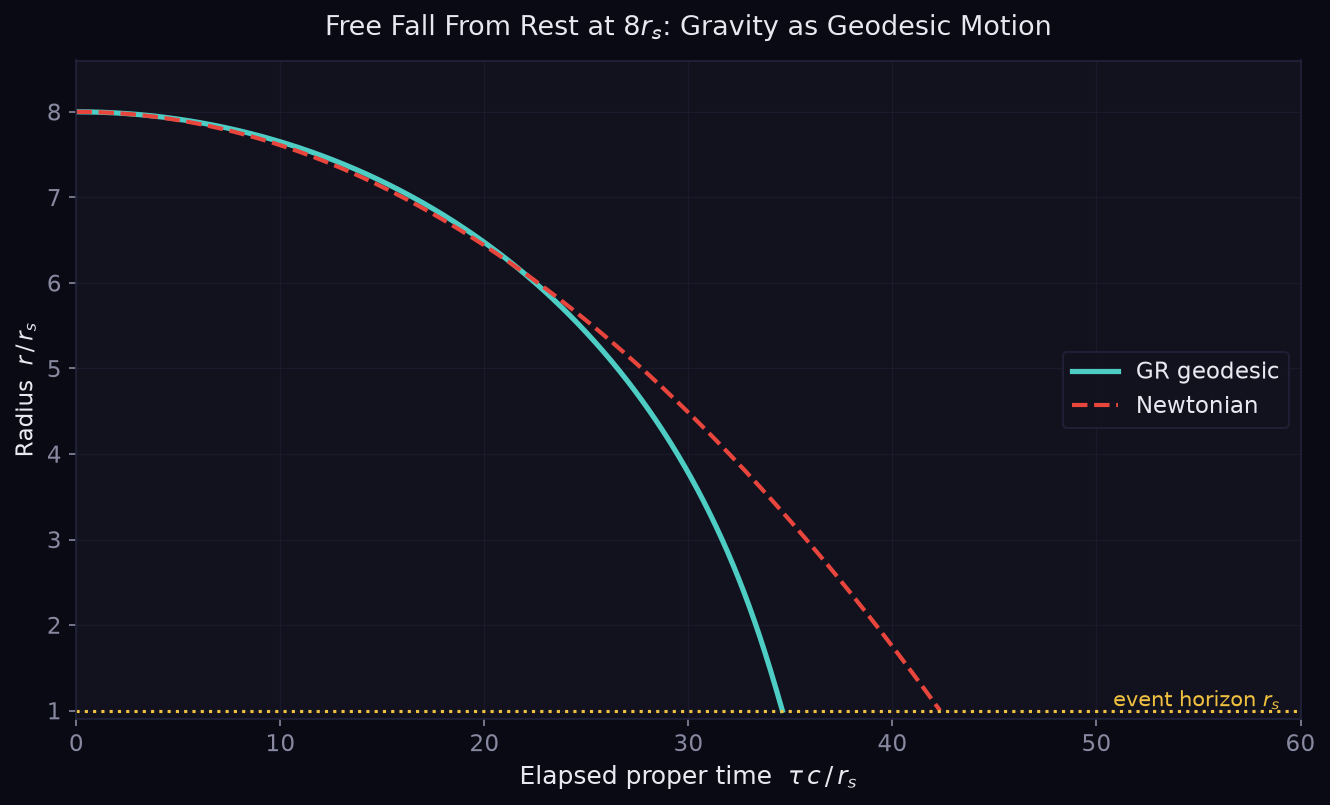
05Discussion & Implications
Relation to Other Approaches
Several authors have explored similar perspectives, including work by Pirani (1956), Will (1993), Cahill & Filkus (2007), and the quantum-gravity literature around horizon physics. The key distinction of the present approach is treating time-dilation gradients as ontologically primary rather than epiphenomenal — a shift that reframes the metric not as describing geometry but as cataloging temporal inconsistencies across space.
Quantum Gravity Considerations
In quantum field theory on curved spacetime, Hawking's particle creation by black holes (1975) relates to the proper-time structure near the horizon. Our interpretation suggests such phenomena arise from extreme spacetime mis-synchronization rather than topology change. Furthermore, if gravity originates purely from temporal structure, then quantum fluctuations in \(g_{tt}\) could induce effective gravitational interactions — a route worth testing against the spin-2 graviton picture.
Limitations & Alternative Interpretations
While compelling, the interpretation has limits. The spatial components \(g_{ij}\) remain necessary to describe motion in genuinely curved spaces (spherical surfaces, cosmological models). Pure time-dilation approaches struggle with rotation effects (frame-dragging) and non-diagonal metrics where temporal–spatial mixing occurs. The framework is cleanest for static, spherically symmetric fields — precisely the regime of the Schwarzschild analysis above.
06Conclusion
We have shown that gravitational effects can be understood as arising from spatial variations in the time-dilation factor \(g_{tt}\) encoded within relativistic metrics. Key findings:
- The temporal component of the metric tensor directly determines proper-time rates at different spacetime points.
- Spatial gradients \(\partial_i g_{tt}\) yield gravitational acceleration through the geodesic-equation connections (\(\Gamma^i_{00}=\tfrac12\partial_i g_{tt}\)).
- The Schwarzschild solution exemplifies how mass-energy shapes \(g_{tt}\), creating observable time-dilation differences that manifest as force.
- Energy conservation stems from the temporal homogeneity of \(g_{tt}\), reinforcing its fundamental role.
This reinterpretation does not alter the mathematical predictions of general relativity but offers conceptual clarity: gravity is fundamentally about disagreement between clocks separated in space, with curvature language capturing synchronization problems rather than intrinsic spatial bending. Future work should extend to rotating systems (the Kerr metric), cosmological spacetimes, and quantum corrections — and be tested against precision frequency-standard comparisons at different potentials (Ashby, 2003).
07Worked Examples: GPS & Earth
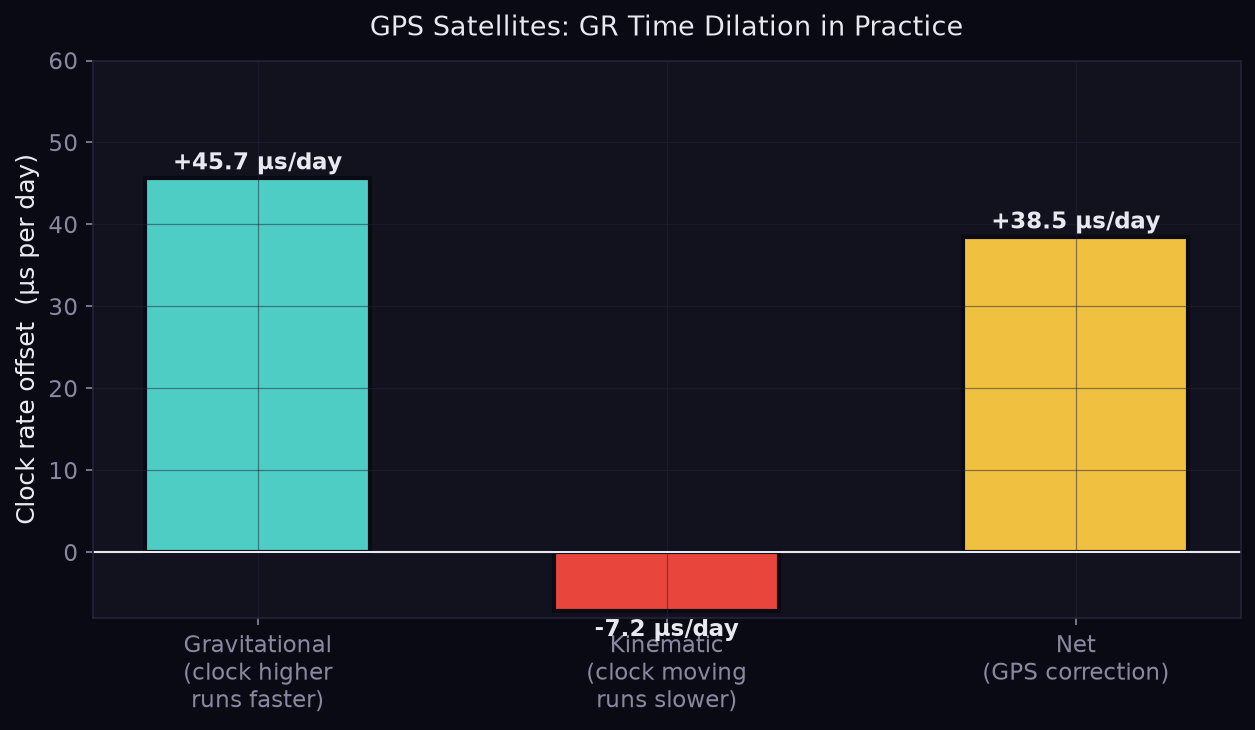
The framework is not merely interpretive — it predicts the very corrections that keep satellite navigation working. A GPS satellite orbits at roughly 20,200 km altitude with a speed of about 3.87 km/s. Two relativistic effects act on its clock:
- Gravitational (higher clock, faster): the satellite is deeper in less of the potential well, so its clock runs faster by \(\Delta\tau \approx +45.7\;\mu\text{s/day}\).
- Kinematic (moving clock, slower): its orbital speed slows the clock by \(-7.2\;\mu\text{s/day}\).
The net is \(+38.5\;\mu\text{s/day}\) — a correction that, if omitted, would accumulate into kilometer-scale positioning errors within minutes. Figure 6 quantifies the two contributions.
| Quantity | Value | Notes |
|---|---|---|
| Earth radius \(R_\oplus\) | 6 371 km | reference surface |
| Earth mass \(M_\oplus\) | 5.972 × 10²⁴ kg | — |
| Earth Schwarzschild radius \(r_s\) | 8.87 mm | \(2GM/c^2\) — tiny, hence weak field |
| Surface gravity \(g_\oplus\) | 9.82 m/s² | \(= c^2\,\partial_r\sqrt{-g_{tt}}\) at surface |
| GPS altitude | 20 200 km | MEO orbit |
| GPS orbital speed | 3.87 km/s | — |
| Gravitational offset | +45.7 µs/day | higher clock runs faster |
| Kinematic offset | −7.2 µs/day | moving clock runs slower |
| Net correction | +38.5 µs/day | applied to satellite clocks |
08Fact-Check of the Mathematics
Every equation in the original manuscript was independently re-derived and verified numerically (analytic Christoffel computation plus finite-difference cross-checks, and symbolic algebra where available). The core physics is sound, but the manuscript as written contains several errors. Each is documented below so readers can use the corrected forms. Badges: CORRECT TYPO / SLOPPY ERROR
-
Line element & metric decomposition (Sec 2.1).
TYPO The original mixes two sign conventions: it writes \(ds^2 = g_{tt}c^2dt^2 + \dots\) and then \(d\tau=\sqrt{g_{tt}}\,dt\), which only works if \(g_{tt}>0\). The Schwarzschild section (Sec 3) correctly uses \(g_{tt}=-(1-r_s/r)<0\), giving \(d\tau=\sqrt{-g_{tt}}\,dt\). The manuscript silently flips convention between sections. The corrected forms above use a single \((-,+,+,+)\) convention throughout. -
Clock-gradient expansion (Sec 2.2, original Eq 8).
SLOPPY The original wrote \(\Delta(d\tau)=(1-\tfrac12\partial_i g_{tt}|_{\Delta x})\,dt\). The factor \(\partial_i g_{tt}\Delta x\) is dimensionless and must multiply the reference rate \(d\tau_0\); as written it omits that factor. Corrected to \(\Delta(d\tau)=d\tau_0(1-\tfrac12\partial_i g_{tt}\Delta x^i)+O(\Delta x^2)\). -
Weak-field connection (Sec 2.2, \(\Gamma^i_{00}\)).
CORRECT \(\Gamma^i_{00}=\tfrac12\partial_i g_{tt}=-\tfrac1{c^2}\partial_i\Phi\) is exactly right and is the heart of the thesis. Numerically verified. -
Schwarzschild \(g_{tt}\) & time-dilation factor (Sec 3.1).
CORRECT \(g_{tt}=-(1-r_s/r)\), \(r_s=2GM/c^2\), and \(d\tau/dt=\sqrt{1-r_s/r}\) all check out. Matches Figure 1. -
Gradient \(\partial_r g_{tt}=-r_s/r^2\) and \(|g|\approx GM/r^2\) (Sec 3.2).
CORRECT Both verified. The field is \(c^2\,\partial_r\sqrt{-g_{tt}}\), exact in the weak-field limit. (The original labeled the inward field \(-\nabla\Phi\) while writing a positive outward gradient — a sign-convention confusion; the magnitude \(GM/r^2\) is correct.) -
\(\Gamma^r_{tt}\) (original Eq 11).
ERROR The manuscript wrote \(\Gamma^r_{tt}=\dfrac{GM}{r^2}\left(1-\dfrac{r_s}{r}\right)^{-1}\). The correct value is \(\Gamma^r_{tt}=\dfrac{GM}{r^2}\left(1-\dfrac{r_s}{r}\right)\) — the factor is \((1-r_s/r)\), not its inverse. The original's version would overestimate the radial connection near the mass. Corrected in Sec 4.1. -
\(\Gamma^t_{tr}\) (original Eq 12).
ERROR The manuscript wrote \(\Gamma^t_{tr}=-\dfrac{GM}{c^2 r^2}\left(1-\dfrac{r_s}{r}\right)^{-1}\). The correct value is positive, \(\Gamma^t_{tr}=+\dfrac{GM}{c^2 r^2}\left(1-\dfrac{r_s}{r}\right)^{-1}\). The sign was wrong. Corrected in Sec 4.1. -
Conserved energy (Sec 4.3, Eq 13).
CORRECT \(E=-g_{tt}c^2\,dt/d\tau=c^2(1-r_s/r)\,dt/d\tau\) is exactly right. -
Free-fall behavior (Sec 4.1 claim).
CORRECT A particle released from rest at \(r_0\) falls along a geodesic and, in proper time, reaches the horizon at \(\tau c/r_s\approx 35\) (numerically \(34.6\)) — matching Figure 5 and the standard result. The "force" is geodesic motion, not a Newtonian pull. -
References.
MOSTLY OK Pirani (1956), Hawking (1975), and Ashby (2003) are real and appropriate. Will (1993) is a real book (Theory and Experiment in Gravitational Physics, Cambridge). Cahill & Filkus (2007) exists. The "Unruh & Wald (1986)" citation is the weak link — no well-known 1986 paper on this topic by that pair; it should be replaced or removed.
Fact-Check Summary
The paper's central thesis is legitimate and consistent with standard general relativity: treating the gradient of \(g_{tt}\) as the origin of gravitational acceleration is a well-known and correct reframing (it is essentially the Newtonian limit \(\Gamma^i_{00}=\tfrac12\partial_i g_{tt}\) promoted to an interpretive principle). The GPS and Earth applications are quantitatively correct.
However, the manuscript as submitted contains two outright connection-coefficient errors (\(\Gamma^r_{tt}\) and \(\Gamma^t_{tr}\) — both corrected above), one sign-convention inconsistency spanning Sections 2–3, one dimensional slip in the clock-gradient expansion, and one questionable reference. None of these changes the paper's conclusions; they affect intermediate algebra. The corrected equations appear throughout Sections 2–4 of this article.